A SIP PBX on one ESP32-S3. No router, no server, no cloud.
Point a few SIP phones at a small board and they can call each other, transfer, park, page and forward, same as on a rack-mounted PBX. The board handles registration and call control; the audio goes phone to phone. It only touches media when a feature actually needs it: echo test, conference, voicemail, hold music, an outside line.
The same C++17 engine also builds as a plain desktop binary for Linux, macOS and Windows. That’s where most of the testing happens.
The board does signalling. The phones do audio. An ordinary extension-to-extension call streams RTP straight from phone to phone, so the board never carries it. That is what lets a microcontroller run a PBX.
The engine is a back-to-back call broker, not an RFC 3261 proxy: it ends each call leg and starts the next one itself, and keeps itself in the dialog by rewriting Contact. SDP passes through unchanged, so two phones that both speak G.722 get wideband; an offer with none of PCMU, PCMA or G.722 is refused before anything rings. ARCHITECTURE.md has the full picture.
A call that does not connect ends at the board. It answers some calls itself and relays the callee’s answer for the rest:
Some features need a party that can play, record or mix sound. For those the board answers the call itself and terminates the media, PCMU only.
Heavy outlines mark the legs where the board terminates the media. Everything else stays peer to peer.
A 911 or 933 is caught before every routing and policy check, including one dialled with a trunk prefix (9911) or produced by a dial-plan rule. Inside the INVITE handler, only dialog, syntax, registration and codec checks come first: a stale dialog draws a 481, malformed From or To a 400, an unregistered caller a 403, and an offer with no PCMU, PCMA or G.722 a plain 488. An offer with PCMA or G.722 but no PCMU is refused later, inside the emergency route, with a 503 Emergency Call Not Routable. Two earlier gates can still drop a 911 before the handler runs: the per-source rate limiter and IP allowlist, which discard the packet silently (open issue #1092), and the SDP admission gate, which yields to emergency only for too many audio streams. Once the call passes those, no operator policy (DND, forwards, dial plan, PIN) can delay, gate or misroute it, and the only route is the 3CX anchor:
Got a board? Plug it in over USB and open the browser flasher (Chrome, Edge or Opera, desktop only). It picks the right image, writes it, and can set up Wi-Fi, a WPA2 passphrase for the access point and the registrar mode before the first boot. If you’d rather do it from a terminal, FLASHING.md has you covered.
No board? Run it on a PC or a Raspberry Pi:
# Linux / macOS
curl -fsSL https://raw.githubusercontent.com/GlomarGadaffi/pocket-dial/main/install.sh | sh

# Windows (PowerShell)
irm https://raw.githubusercontent.com/GlomarGadaffi/pocket-dial/main/install.ps1 | iex
Or build it yourself:
cmake -B build -S . -DCMAKE_BUILD_TYPE=Release
cmake --build build --config Release
./build/SipServer --ip 127.0.0.1 --port 5060 --web 8080
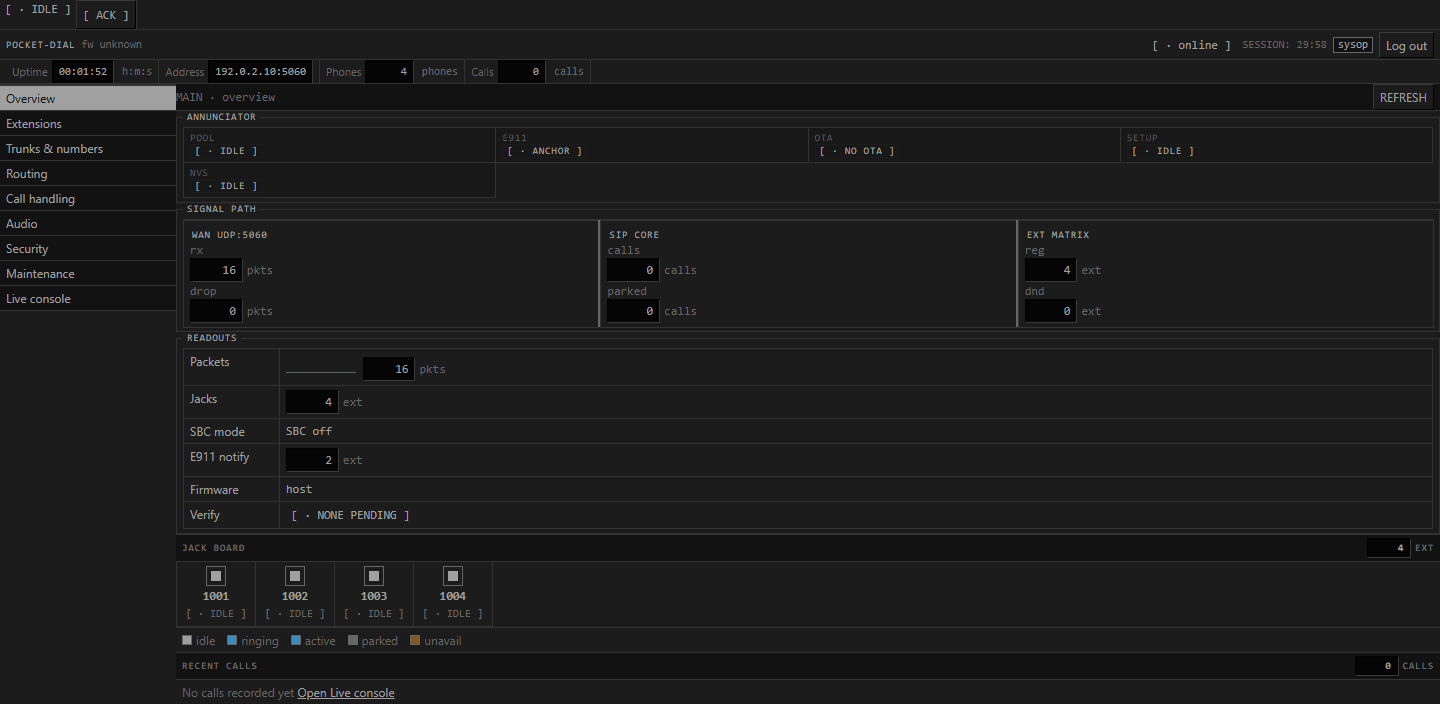
Then open http://127.0.0.1:8080, point two softphones at sip:127.0.0.1:5060 as 1001 and 1002, and dial 777 for an echo test or 999 to page everyone. The setup guide walks through the rest.
Replaces (RFC 3891).700–709 to park, dial it again from any phone to pick up.*8 for your group, **<ext> for one extension.980–989, and 999 to page everyone.dialog event package (RFC 4235).888, voicemail, hold music, and a dial plan of up to 16 rules.Not all of this has been exercised on real hardware yet. The feature roadmap is honest about which features have, and which have only passed the host tests.
| Image | Board | Good for |
|---|---|---|
eth | ESP32-S3 + W5500 Ethernet. Default board: LilyGO T-ETH-ELITE S3 (802.3af PoE) | An office closet. The best-tested path. |
wifi | Any ESP32-S3, running its own access point | A bag, a field site, a demo. No cables, no router. |
display | Guition JC3248W535 (3.5" touchscreen) | A wallboard that shows what the PBX is doing. |
lan8720 | Classic ESP32 + LAN8720. Build from source. | Older boards you already own. |
Pin maps, wiring and parts lists live in HARDWARE.md. PHONE_COMPATIBILITY.md covers which phones work, and how well.
pocket-dial assumes a flat, trusted local network. Out of the box:
wifi image boots an open access point. Anyone in radio range can join. WPA2 is one setting away, and it covers the dashboard, the signalling and the call audio in one go.admin / admin and won’t do anything until you change it. On a fresh board, whoever reaches the dashboard first owns it.That is Learn mode: trust on first use. Switch the registrar to Secure and every REGISTER is digest-challenged; an extension with no stored secret cannot register at all.
Which all adds up to one rule: do not expose UDP 5060 or the dashboard to the Internet. Not with a port forward, not “just for a minute”. The threat model spells out what’s defended, what isn’t, and why.
v1.8.0 (2026-11-18) is current: 8 pull requests since v1.7.0, on memory pressure, soaked on two boards. The flasher offers it and every earlier tag; images and checksums are on the releases page too. main runs ahead of the latest tag between releases, and the changelog tracks what changed and what’s still a known gap.